
Grady County Sex Offender Checks
The Georgia Sex Offender Registry is the main public source for Grady County. The Georgia Bureau of Investigation and Georgia Crime Information Center manage the central system, while each sheriff must keep accurate information for registrants in its own jurisdiction. That division explains why a public search and a call to the Grady County Sheriff's Office can serve different needs.
Use the state portal for names, addresses, maps, listed offenses, and registration status. Call the Sheriff at 229-377-5200 when the concern is local registration, a possible move that is not reflected online, or suspected noncompliance. For someone who may have crossed a state line, add the federal national search. No verified Grady County proximity-alert program or sheriff app was found in the official sources.
Grady Registry Map or Name
A name query works best when the spelling is known. A location query is better for community awareness around a street, ZIP code, Cairo, Whigham, or Grady County as a whole. Neither method proves that a similar name or nearby marker is the person or address the searcher had in mind.
The map and list are two views of the same state data. Review the full profile before drawing a conclusion. Match several fields, note the registration status, and check when the entry was updated. An address marker may need more context than the result screen supplies. Search both the city and county fields when a mailing address falls near a boundary. If one view fails to load, the list can still provide profile links for review.
Georgia Sex Offender Registry Searches
The official registry is free and applies its own disclaimer and terms. Start broad enough to catch spelling or location differences, but narrow the results with fields that are truly known. Do not guess at a date, address, or status merely to force a match.
- Open the Georgia registry and review its conditions of use.
- Choose a name search or use county, city, ZIP code, address, or geography controls.
- Select Grady County when the goal is a county-wide result list.
- Open a possible profile and compare its status, description, address, offense, and update information.
| Field or control | Type | Required | Use |
|---|---|---|---|
| First name | Text | No | Pairs with a known name |
| Last name | Text | No | Spelling affects results |
| Status or offender type | Filter | No | Options may change on the live form |
| County | Select | No | Choose Grady for county scope |
| City or ZIP | Text/select | No | Useful for Cairo or Whigham |
| Address and radius | Geographic | No | Use the live offered distances |
| Map or list | View | No | Changes how results display |
A view of the official Georgia registry search shows the public controls used for a Grady County lookup.
The interface reinforces why location and identity fields should be checked together rather than treated as separate proof.
Missing Grady Registry Results
A blank result does not support a firm claim that no registration duty exists. The GBI says a person may be absent because the search input is wrong, the person is deceased, the person does not meet Georgia's requirements, or a new registration has not yet reached the state system. Successful completion under Georgia's First Offender law can also affect whether a person appears. Juveniles do not register unless they were tried and convicted as adults.
The GBI registry FAQ explains these public limits and the statutory triggers.
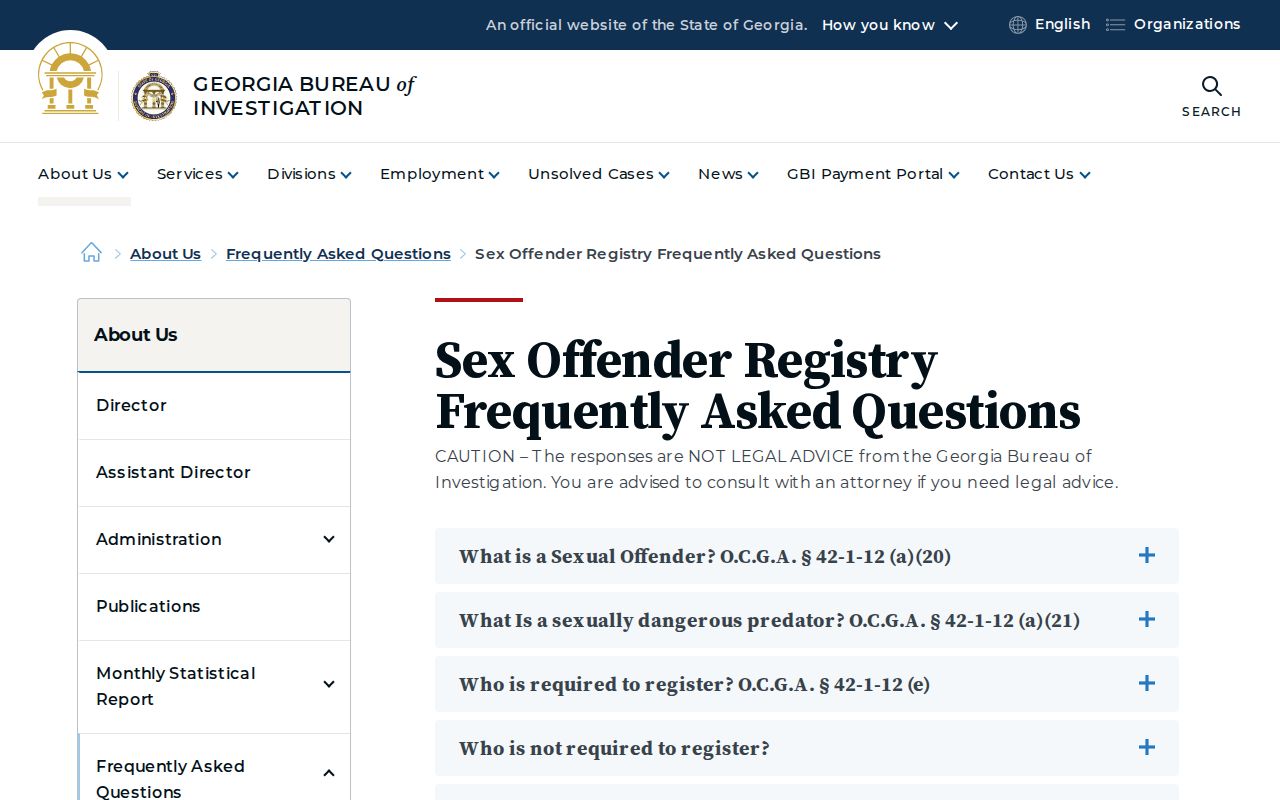
Those limits make the Sheriff the right local follow-up when a Grady County address, move, or compliance issue appears out of date.
Registry Profiles: What They Show
A live profile may display identity and physical traits, an address, registration data, and facts about the qualifying offense. The exact public schema can change, so the current portal controls. A profile should not be copied into a separate local list or used to imply facts it does not state.
| Name and aliases | Published identity names connected to the registration record. |
|---|---|
| Photo and description | Image plus sex, race, age or birth data, height, weight, hair, eyes, and possible marks. |
| Registered location | Public address and Grady County location data shown by law. |
| Offense details | Description or statute, conviction date, and jurisdiction when displayed. |
| Risk and status | Georgia classification, registration status, and update or verification information. |
| Other public fields | Vehicle, school, or work data only when the live profile lawfully displays it. |
Read the offense jurisdiction and conviction date with care. The listed address and registration duty concern current public notice, while the qualifying court case may be much older.
Grady Sheriff Registration Questions
The Grady County Sheriff's Office is the local registration and verification contact. Its official site does not publish a separately named sex-offender unit, public verification calendar, app, or local alert system. Direct registry questions to the main office instead of assuming a special counter exists.
Grady County Sheriff's Office
115 16th Avenue NE
Cairo, GA 39828
229-377-5200
Mail: P.O. Box 690
County-published hours: Monday through Thursday, 8:00 a.m. to 5:00 p.m.
Report possible noncompliance with concrete facts, such as the listed profile, observed location, and relevant date. The public should not attempt to investigate, confront, enter property, or enforce registration law.
Note: A registry concern belongs with law enforcement; an emergency or immediate threat should go through 911.
Registration Levels and Duties in Georgia
Georgia uses Level I, Level II, and Sexually Dangerous Predator risk assessments under O.C.G.A. § 42-1-14. These categories are risk classifications. They are not the same as a generic federal tier chart, and they do not support a simple ten-year, twenty-five-year, or lifetime table copied from another state.
| Georgia classification | Meaning | Duration and public effect |
|---|---|---|
| Level I | State risk-assessment classification | Registration is generally for life unless a court grants release authorized by Georgia law. |
| Level II | State risk-assessment classification | Any release depends on the governing statute, offense, time, supervision, and court findings. |
| Sexually Dangerous Predator | Highest named Georgia risk classification | Special statutory duties apply; verify the current law and profile. |
Georgia law also contains distance restrictions for certain acts and classifications. The rules can depend on the offense date and an exemption. A broad claim that every registered person faces the same 1,000-foot rule would be inaccurate, so current statutory text and official case-specific guidance matter.
Grady Searches Across State Lines
The Dru Sjodin National Sex Offender Public Website is the U.S. Department of Justice layer for participating jurisdictions. It is useful when a person moved, works across a border, or has an offense or registration record outside Georgia. It supplements the Georgia portal rather than replacing it.
The national search page provides a single starting point across state, territorial, and tribal systems.
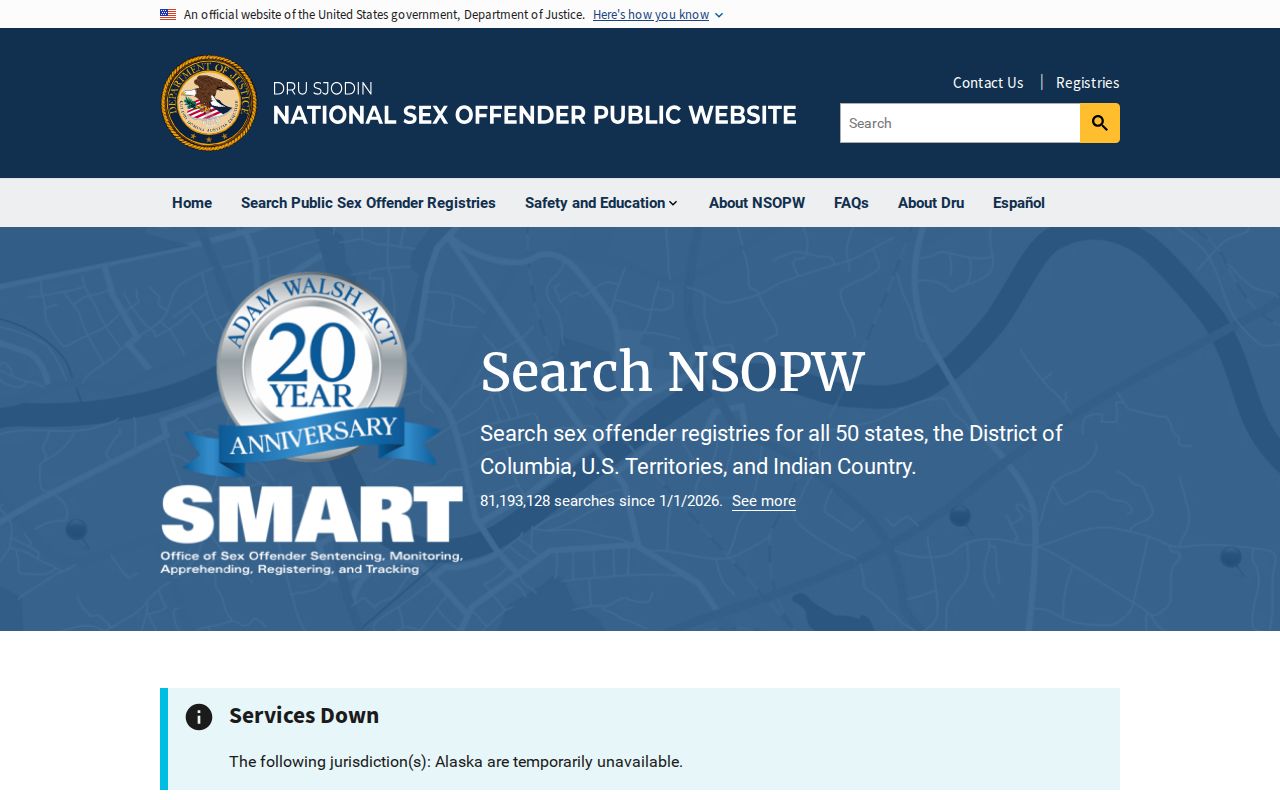
Return to the source jurisdiction's profile for the latest details, then contact the Grady Sheriff only for local facts within its authority.
Grady Registry Status Is Not Arrest
Registry presence records a statutory duty associated with a qualifying case. It is not evidence of a new Grady County arrest, a current charge, or unlawful conduct at the listed home. Likewise, a profile's absence does not prove that the person has no criminal court history.
For a current prosecution, the clerk-held case file is the proper source. For a recent custody event, the Sheriff's booking record answers a different question. Keeping these systems separate prevents an older registry entry from being read as a new event.
The date fields matter. A conviction date describes the court event that led to the duty. An address or verification update concerns the registry process. A person may lawfully remain on the Grady County registry long after the sentence or supervision ended because Georgia generally treats registration as a lifetime obligation unless a court grants statutory relief. None of those dates, standing alone, reports a fresh police contact.
Using Registry Information Lawfully
Georgia makes registry data public for awareness and safety planning. Searchers may use it to understand listed locations, discuss family safety, and give law enforcement a factual report about suspected noncompliance. The portal does not give anyone authority to confront a registrant, enter property, threaten a household, or act as a private enforcement officer.
Use the registry lawfully: O.C.G.A. § 42-1-12 governs Georgia's public registry. Harassment, threats, intimidation, trespass, or other misuse can lead to criminal or civil consequences.
Confirm information with the office that maintains it. Profiles can change after a move, verification, correction, court order, or agency update. Community awareness works best when it is tied to the live official record and reported through lawful channels.
If a profile seems wrong, record the public profile reference and the specific field at issue. Then call the Grady Sheriff for a local address or compliance point, or the listed source jurisdiction for an older conviction fact. A measured report gives the proper agency something it can check. Public reposting, speculation, or contact with the household does not correct the official registry and can cause harm.